Scopique
 Scopique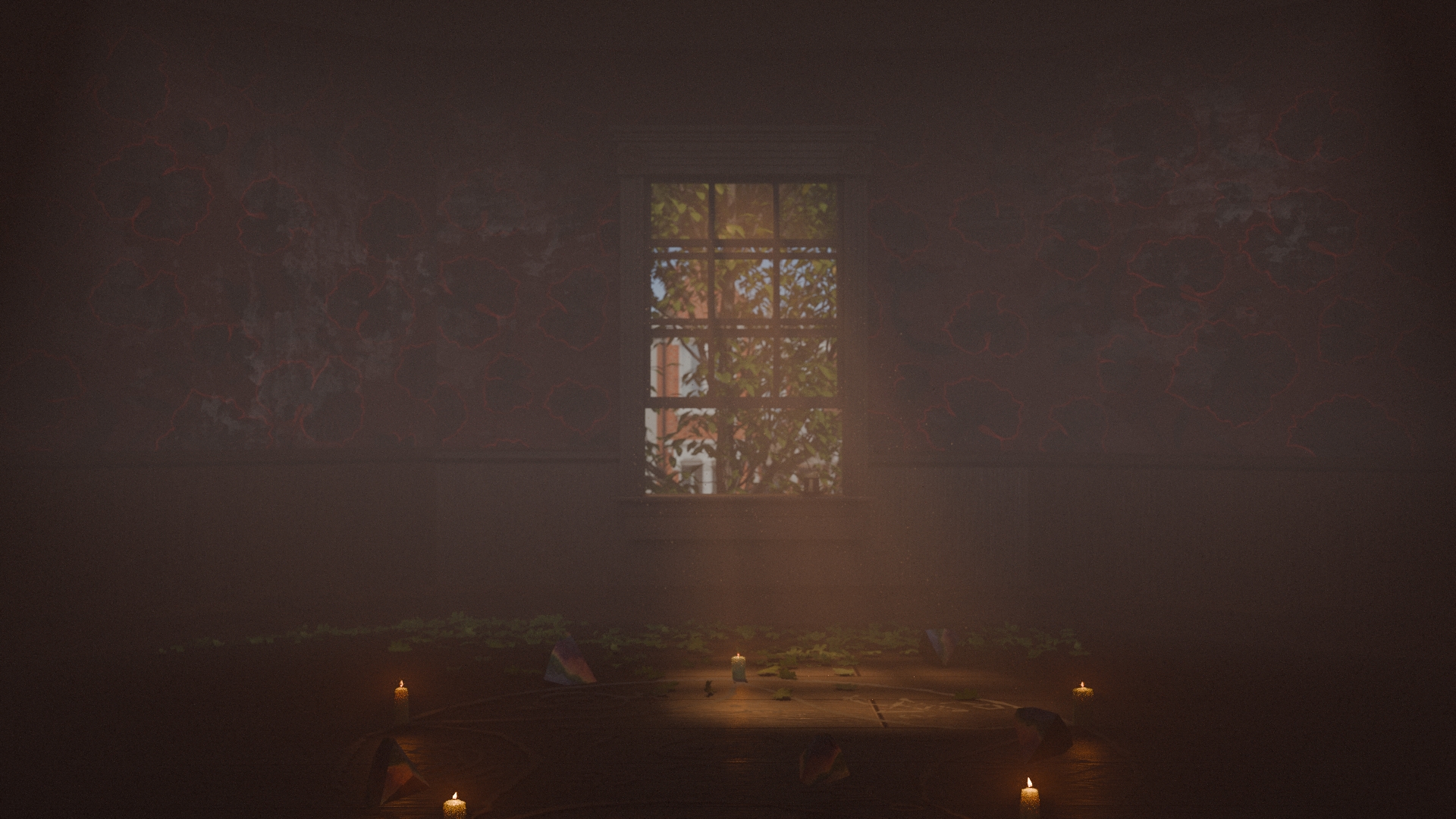
Originally this post was going to talk about the process of creating this render, but I feel that without suitable context, it’s just “an image” and I’d like it to be more than that; I’d like folks to maybe feel the purpose in the image, both why I chose it and what it means in the context of it’s source.
The source
This is my interpretation of a scene from my favorite novel, Imajica by Clive Barker. It’s a complicated story with a lot of characters and a whole lot of details. For the purposes of this image, this is my interpretation of the room in which the story’s protagonist, known as Gentle, engages in the ritual that will reconnect the Dominions of the Imajica.
Interpretations are kind of tricky, especially those of which appear in books because when reading, everyone has their own version of a scene in their minds. I tried to skim through the novel to find passages that related to the “meditation room”, as it’s called, but there weren’t many, so I had to fill in some blanks, remove some aspects which didn’t fit into the shot, and probably took some liberties mainly because I forgot ancillary details that weren’t immediately influencing the passages I managed to find.
The purpose – within the story
There exist five Dominions. Three of them are connected. The Fifth — a.k.a. Earth — is adrift. The First Dominion is technically still connected, but is inaccessible due to a shroud raised by it’s sole inhabitant, God, or as he is named, Hapexamendios.
Gentle is actually the Maestro Sartori, and one of the very few survivors of an ill-fated attempt 200 years ago to reconcile the Dominions of the Imajica into one continuous whole. Because of his part in the original disaster, Sartori had asked his familiar, the Mystif Pie ‘oh’ Pah, to make him forget his life every 20 years. Sartori now lives as John Zacharias Fury, or Gentle and 200 years later, is reunited with Pie ‘oh’ Pah who helps him remember who he is and his purpose.
At the same time, it’s a story about a woman named Judith. 200 years ago, Judith was fought over by Sartori and one of his Patrons, Lord Godolphin. As a compromise — and unbeknownst to Judith — the two men agreed that Sartori would make a copy of Judith who would be loyal to Godolphin and his descendants for the rest of time. During this ritual, however, Sartori inadvertently cloned himself as well. This doppelganger, claiming the name Sartori for his own and enraged by the circumstances of his existence, derails the Reconciliation and escapes with the original Judith (now known as Quaisor) to the Second Dominion where the two ruled from a mountain-city called Yzordderrex.
As both Gentle and Judith re-learn their histories both apart and repeatedly together over the past 200 years, their paths diverge on last time. Gentle, discovering that he is the son of Hapexamendios, believes that as the Reconciler he is about his father’s work. Judith, however, discovers that Hapexamendios was not the original deity of the Imajica; in fact, it was a cabal of goddesses who were struck down or imprisoned by him on his way to the First Dominion. She becomes an unintentional savior and ally of the goddesses by freeing Gentle’s mother, Celestine, from her prison so that she might confront Hapexamendios for a true reconciliation of the Imajica.
This is an incredibly reductionist summary of the story, focusing on tangible assets that might carry some kind of understanding forward. In truth, Barker admits that the story started when he was thinking “about the images which appear in the great paintings of Christian mythology“. Although the book is fantastic example of “urban fantasy”, it’s constant subtexts include Christianity, the struggles between a patriarchy and a matriarchy, and eroticism. You know, as one does.
The purpose – the image itself
Imajica is a dense story, and pretty much all of it is well beyond my abilities to tackle for a subject to model. I chose this room as a focus because…it’s a room. It exists in the story at 28 Gamut St. Clerkenwell, London, was the place where Sartori first attempted Reconciliation, and where Gentle attempts it again 200 years later. After being abandoned for so long, however, the room is empty, the floors bare, and the walls covered in rot and mildew.
The story provides only a few specifics on this room. We know that it’s at the front of the house because Sartori used to watch a young woman named Allegra who lived across the street from this window. I have recollections of some other details which may or may not be accurate (I have read this book over 20 times since the first, back in the mid-90’s). I made the room non-rectangular which is something I may or may not have misappropriated to fit my personal interpretation for it. Based on a few descriptions, there is a window (at least one) and a fireplace which I could not fit into the scene based on the camera’s placement. I assume the viewer is observing from the doorway.
There are some specific passages which I’ve incorporated into the image. The walls are discolored and mildewed. There is a ritual circle drawn, somehow, on the floor. The presence of the leaves is a bit harder to relate; it’s not simply that the window is open. Gentle had turned one of Sartori’s agents, a creature called Little Ease, to his side, and this creature had been stripping leaves from the tree outside the window and flinging them into the room in order to better see any dangers approaching from the street. I figured that these leaves would still be present during and after the ritual. The candles were mentioned as being placed on the mantle, but since I didn’t have a mantle, I placed them on the floor. The magical stones about the circle are part of what allows Gentle’s spirit to leave Earth, traverse the dangerous void called the In Ovo, and meet with Maestros from the other Dominions to perform the ceremony.
The significance of light
This image represents the aftermath of the Reconciliation, 90’s edition. At this point, Gentle has been successful in his endeavor, has reunited with Pie ‘oh’ Pah, and the two have effectively left the Imajica for points undiscovered. Sartori is dead and his plans to disrupt the Reconciliation a second time were thwarted. Hapexamendios and his empty city have been destroyed by his own rage, with help from Celestine. Here, God really is dead.
Judith, however, lives, and gives birth to Sartori’s child. In the days following the Reconciliation, the revolution in the city of Yzordderrex, and the death of Hapexamendios, the goddesses return. They are preceded by intense floods that wash away the corruption and filth that Sartori had built, and cleanse the ruins of the First Dominion as well. Judith finds herself among them; I suppose whether or not she becomes part of their pantheon is up to the reader.
After the Reconciliation and everyone spread out according to their destiny, I envisioned that this room was abandoned (though it was mentioned that some of Gentle’s friends were leading tours of newly arrived visitors from other Dominions to 28 Gamut Street to see where it all went down) and left as it was. It’s true that although the Reconciliation of the Fifth Dominion was steered from there, it was also a place where many people had died, and where an atrocity was forced upon the original Judith 200 years prior. None of the horrors could be rolled back, but with a complete Imajica, a new era can begin; the light represents a cleansing of the space to make it sacred as befitting it’s role.