Scopique
 Scopique
Tools matter to me. There’s something in my brain that has me thinking that if I had just the right tool which allowed me to work in just this specific way then I could be productive as all hell. What it really means is that I spend a lot of time evaluating different tools and approaches, and rarely make progress in the project I’m trying to support. I should probably get myself tested. I think I’d score pretty well.
This time, it’s Amsel Suite.
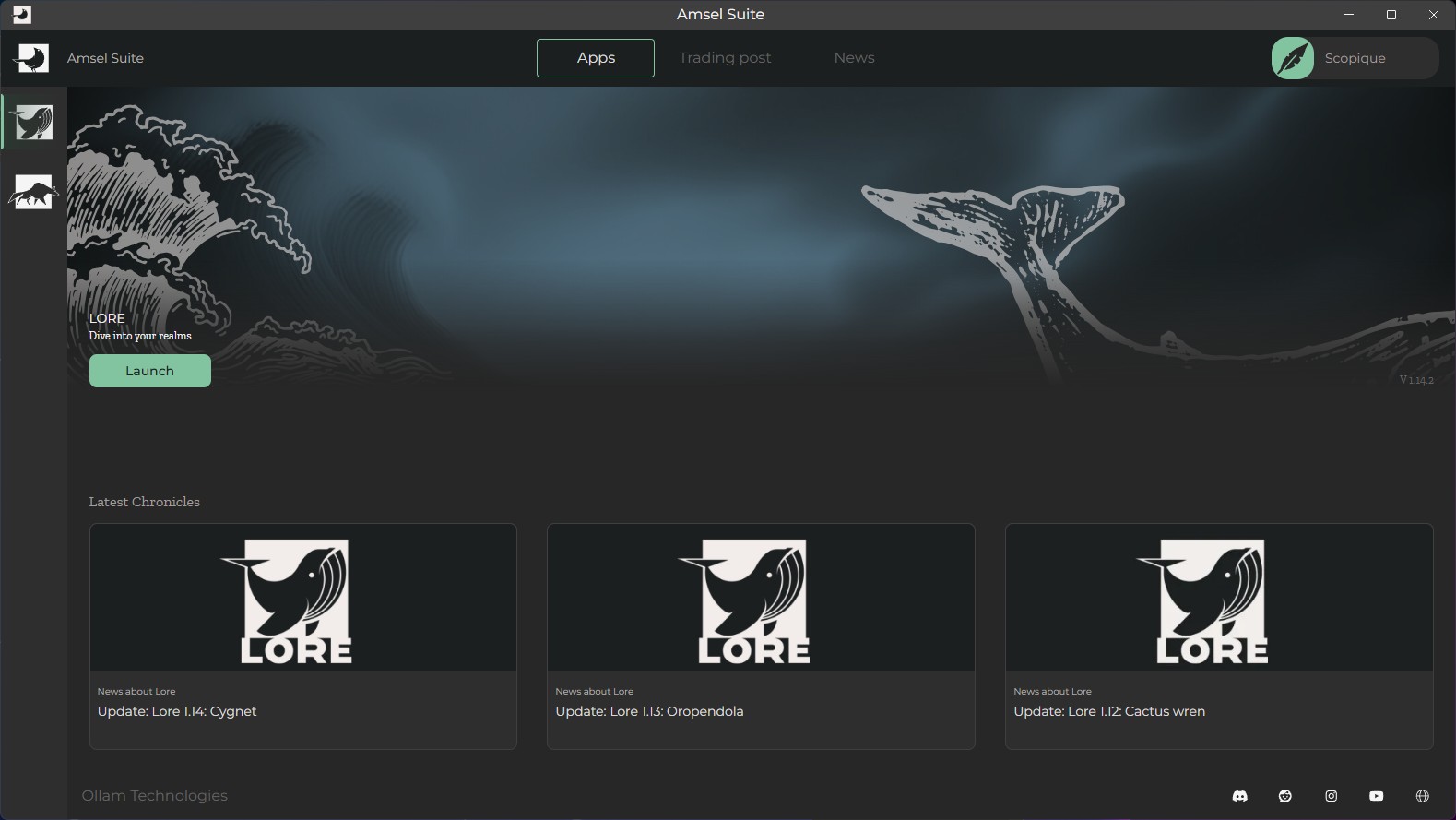
Amsel Suite is a set of tools for TTRPG worldbuilding and game session management. I hate to keep adding this as an asterisk, but if I don’t, someone will either ask or misconstrue, so here it is: this is NOT a VTT.
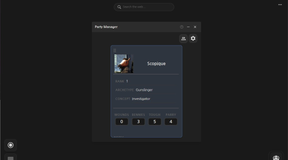
Amsel is currently two tools. LORE is for creating worlds, acting as the “game bible”, and TOME is for tracking gameplay sessions. Both are aimed at the GM, not the player, although developers Ollam Technologies are working on two new apps for the suite, HARP, for ambient audio, and SCRY, which looks to be a way for players to hook into the GM’s TOME document to keep their own notes, track their sessions, collaborate, and schedule gameplay times. Still, not a VTT I cannot stress that enough.
Amsel is a buy-once, use forever app that requires no internet connection; your work lives on your local machine for better or worse (back up your data, kids!). It’s available for Windows, Linux, and Mac, and for those who like to get riled up one way or another, it contains no generative AI integrations. It does, however, have a marketplace available through the launcher. Right now you can download some free “LoreKit” primers, and there are three premium themes on offer for about $10USD. I do hope that we’ll be able to create our own themes in the future. In honor of Halloween, the “REDRUM” horror theme is on sale for only $7USD, so I might pick that up considering I’m working on content for The Secret World SWADE. Spooky!
Even though it’s a two-app suite, I have only focused on figuring out LORE thus far, so I’ll give a little talk about that. Later, I’ll add a similar post focusing on TOME.
Making it All Up
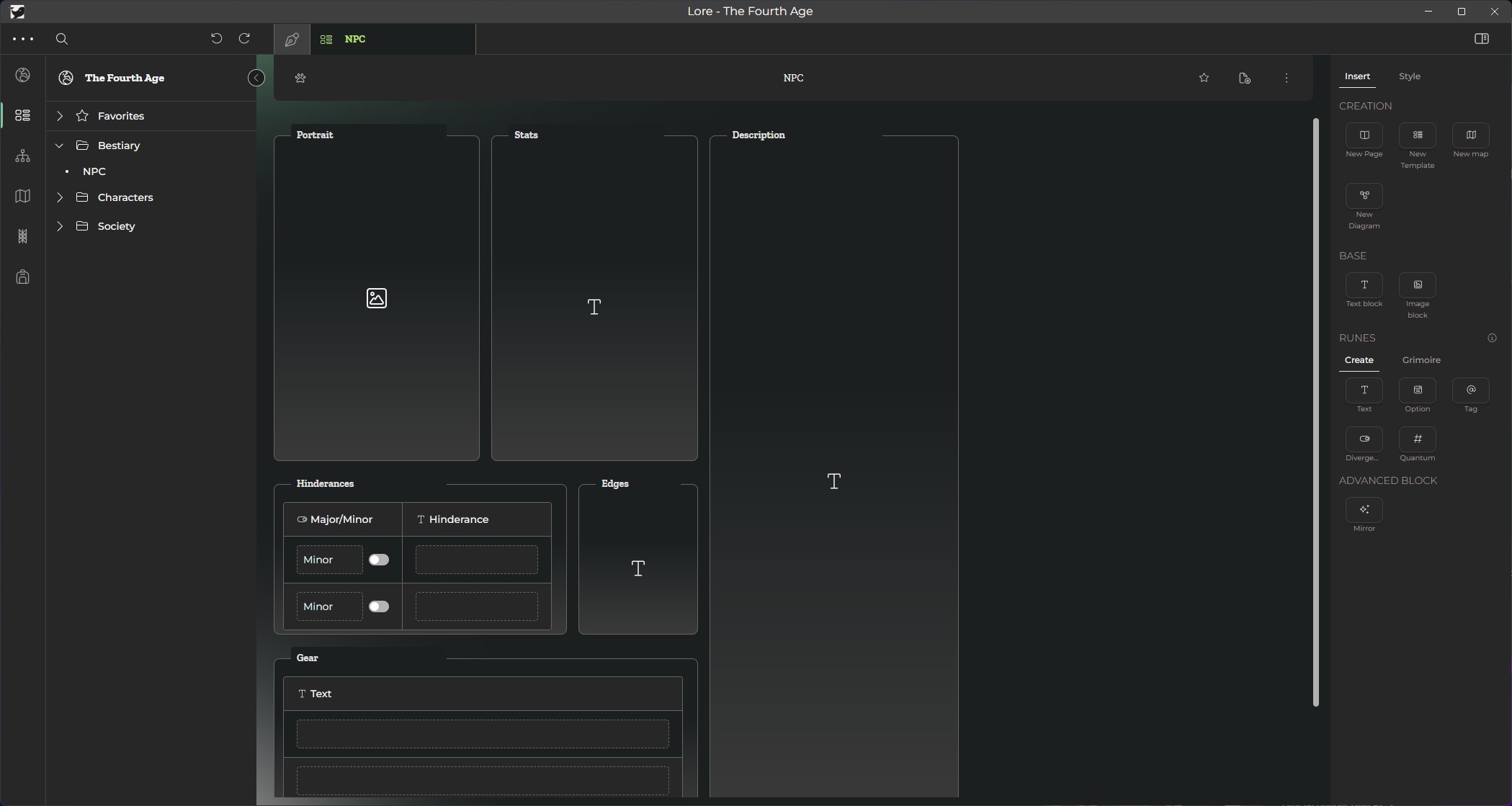
The thing I like the most about LORE is that it’s non-opinionated. It doesn’t come primed for D&D like so many other apps out there; in fact, it demands the GMs to stare into the abyss, if the abyss was an empty canvas.
The first task is to create a template under an organizational heading such as “Bestiary”, “Geography”, “Society”, or “Game System” (or you can create your own category if you don’t like what’s provided). Templates use widgets called “runes” which can be dragged to the canvas surface, resized, re-arranged, and set up in whatever way the GM feels will benefit their use of the app.
Putting it to Good Use
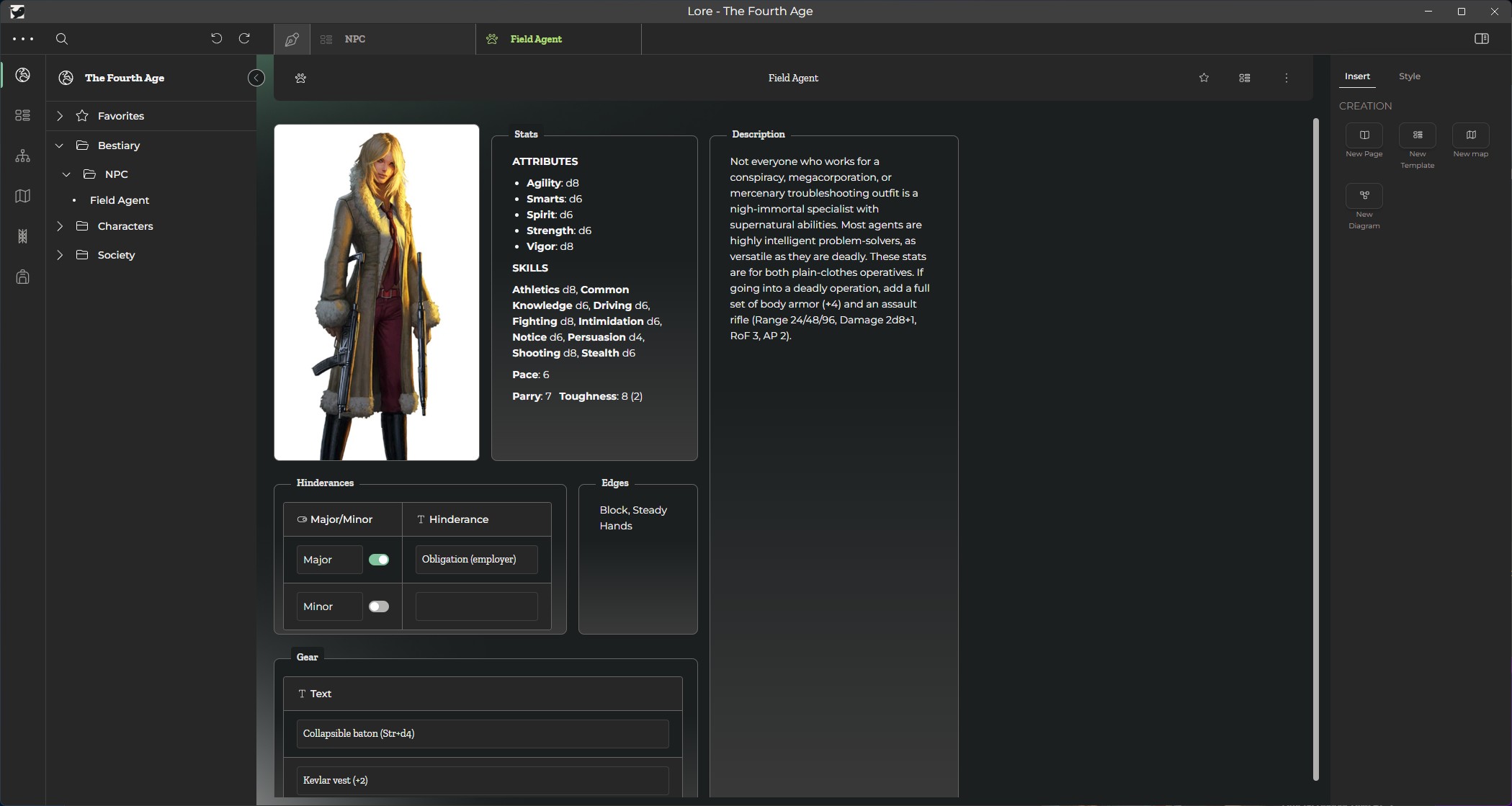
Once a template is created, it can be used to record the data in a page. Here, all of the runes are functional and can record text, upload and display images, and act as hyperlinks to other pages. Many of the runes have advanced functionality, such as the “divergence” rune which toggles between two states, or the “option” rune which is basically a drop down list of hard-coded values.
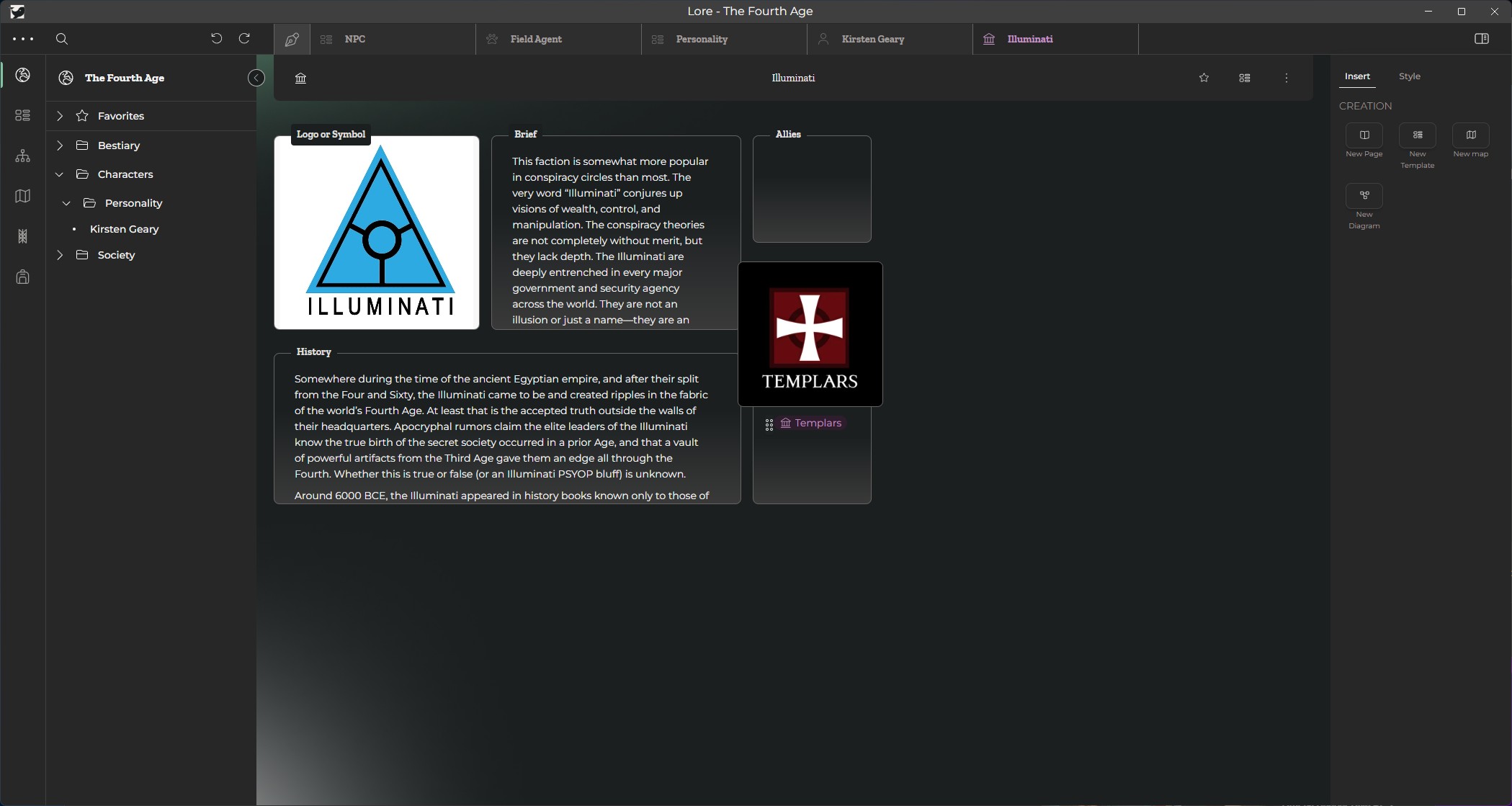
Because it’s a system, one of the best features is the hyperlinking reference. Templates can use a “tag” rune which links to another page, but any text field (multi- or single-line) can use “@” to bring up a list of other pages. Each of these links can display a hover card (chosen when creating the template) and when clicked, will open the associated page.
Runes can be combined into a compound widget, which can then be saved to the file’s “grimoire” library for use within other templates. Used creatively, this welding allows GMs to create interesting data containers which will probably satisfy someone’s needs, somewhere.
Verdict? The Jury is Out
I feel it necessary to admit to myself, in print, that I have just deleted several paragraphs worth of “cons” about LORE. In the heat of my bitch-fest I decided to poke around in the app’s settings with a fine-toothed-comb, and ended up solving the headache that would have prevented me from recommending this to anyone. Since the solution on hand works (although not in the way I wished it did), my outlook has changed significantly.
My biggest appreciation is that LORE is non-opinionated. I despise developers who have OTRPGSM — Other Table-Top Game System Myopia — and create an otherwise excellent tool but only for D&D. I get it; you’re putting your eggs in the biggest commercial basket, but apps like Amsel and Mithos seem to “get it” by not only choosing to not favor any one system, but by allowing users to use these apps in literally any way they want through their template systems.
My biggest issue now is that there is no official, comprehensive documentation to be found. I originally found a third-party YouTuber who was providing overviews into LORE and TOME, but I couldn’t deal with his meandering focus. I only just found some unofficial community written documentation on the fucking Discord goddammit I hate Discord, buried in the “community content” channel. While there is a series of onboarding tutorials built into the app, the stories are broad and the incomplete inclusion of tooltips throughout the app means I’ve had to piece together information by trawling through Discord using the “Search” functionality. That’s a level of Hell no one deserves. Never skip documentation no matter how intuitive you believe your product to be.
Now that I’ve solved my original roadblock and feel that I have enough of an understanding of the app to use it in a competent fashion, I do feel better about recommending LORE. In fact, before writing this post I was working on a video tutorial and overview of LORE. I was debating whether to write this post or make that video, so while you’re reading this you know which route I chose to take. I’m not entirely sure that I’ll abandon the video, though.
Addendum: Why LORE Over [Insert Favorite Tool Here]?
I can’t answer this for you, and only want to include this footnote because I know someone is going to drop into the comments to recommend some other tool, as if this post were asking for input. I appreciate the concern and your personal excitement about what works for you, but I’ve tried a whole lot of other tools, some paid, some free and while I like a little bit about a lot and a lot about a few, none have given me everything I need. I don’t expect Amsel to do so, either, but I have to give it a shot.
World Anvil comes to mind, but it’s web-only and the data is stored on their servers. It’s also gargantuan and has so many features that I felt overwhelmed when using it. So I rarely did.
Obsidian is still my bedrock because it’s free, it’s fun, it’s easy to use, and has a lot of mod support. It’s also lacking a whole lot of that [rubs fingers together] texture that my brain insists we have in order to feel like I’m going to be able to make meaningful progress. I try, but I will always feel like something is missing.
My two VTT children, Fantasy Grounds and Foundry, are also excellent options but while they are both buy-once, store locally, they also lock content into not just their bespoke platforms, but also the insinuation that I’m going down the VTT route. Honestly, if I’m playing a TTRPG these days, it will be via VTT, but I don’t want my content to live there.
Google Docs…get the hell out of my house with that. You might as well be writing down your content on the back of napkin with a crayon.