Scopique
 Scopique
After posting my post about Star Citizen’s engineering updates, I put my money where my mouth is and downloaded the PTU client. I jumped in, called up my Apollo MediVac, and took a spin through the new “feel” of the system while sitting in the hangar.
First up, only about 80 ships (out of 200+) will have “full implementation” of the system when 4.5 releases to the live servers. That means engineering consoles and MFD, fuses, and swappable components via tractor beam/inventory/MOBI. An additional 30 ships will implement “partial” engineering which could be any mix of the above systems, with I guess the bare minimum being access to the engineering system via MFD (as a pilot is technically the most important engineer in any ship, large or single-seated).
I chose the Apollo to test with as it’s a very recent release and I figure that it would be one ship that I own that would fall into that 80-ship column.
Engineering Console
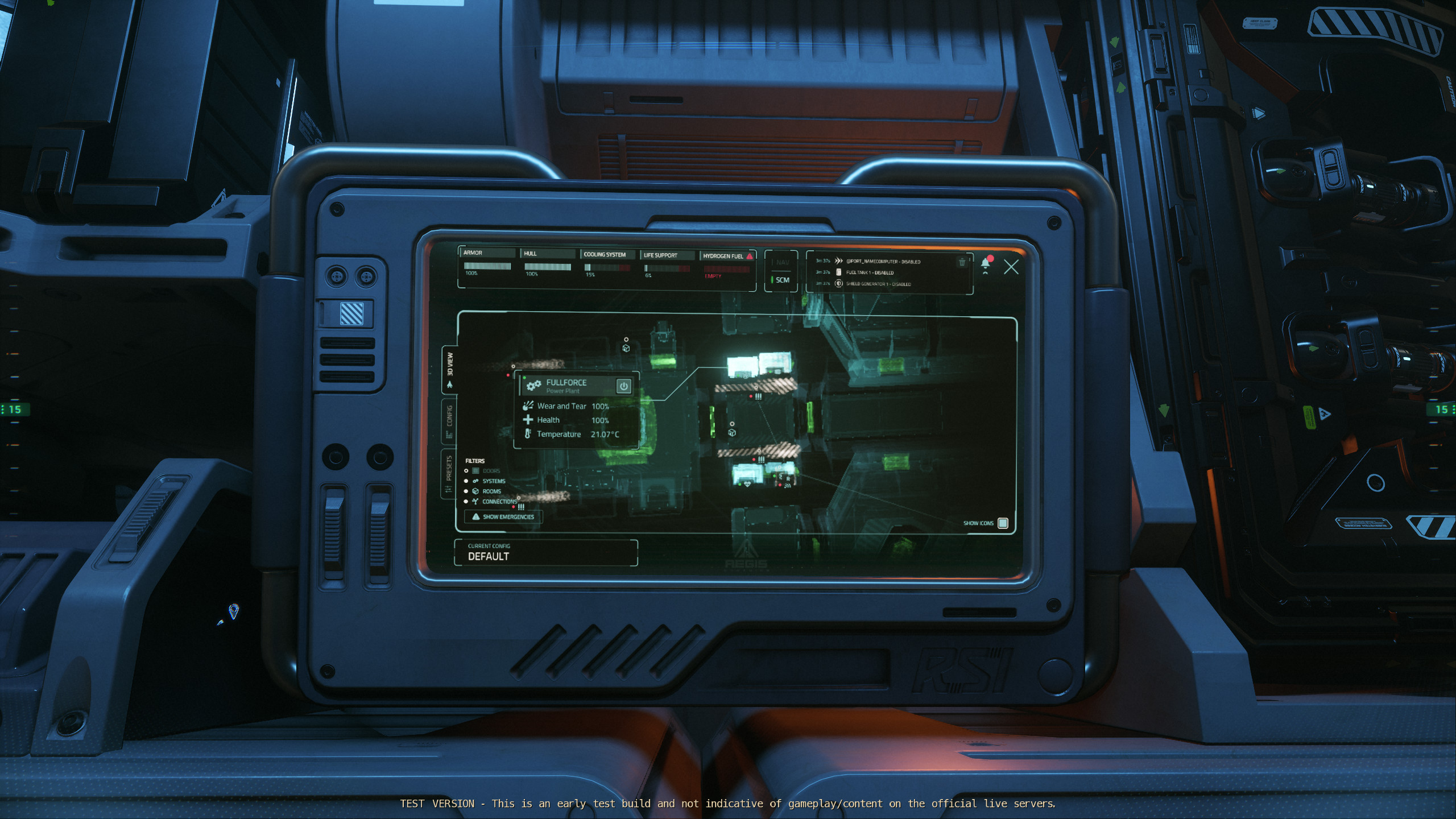
The engineering console is pretty good overall. Specifically, though, the placement of these screens is going to add or subtract from the experience. The Apollo’s engineering screen is behind a sliding bulkhead alongside the fuse panel and some components. That puts it at a very awkward angle. Unlike the ASOP terminals in stations, activating this screen does not force a zoomed-in view, and that makes a lot of the on-screen text pretty unreadable. I did try the system out in a Cutlass Red, and that terminal was available in the cockpit near the beds which made it much more accessible and easier to use, so CIG should now re-do the placement of some of these terminals, or add the zoom-in feature seen on the ASOP terminals so we can read the screens.
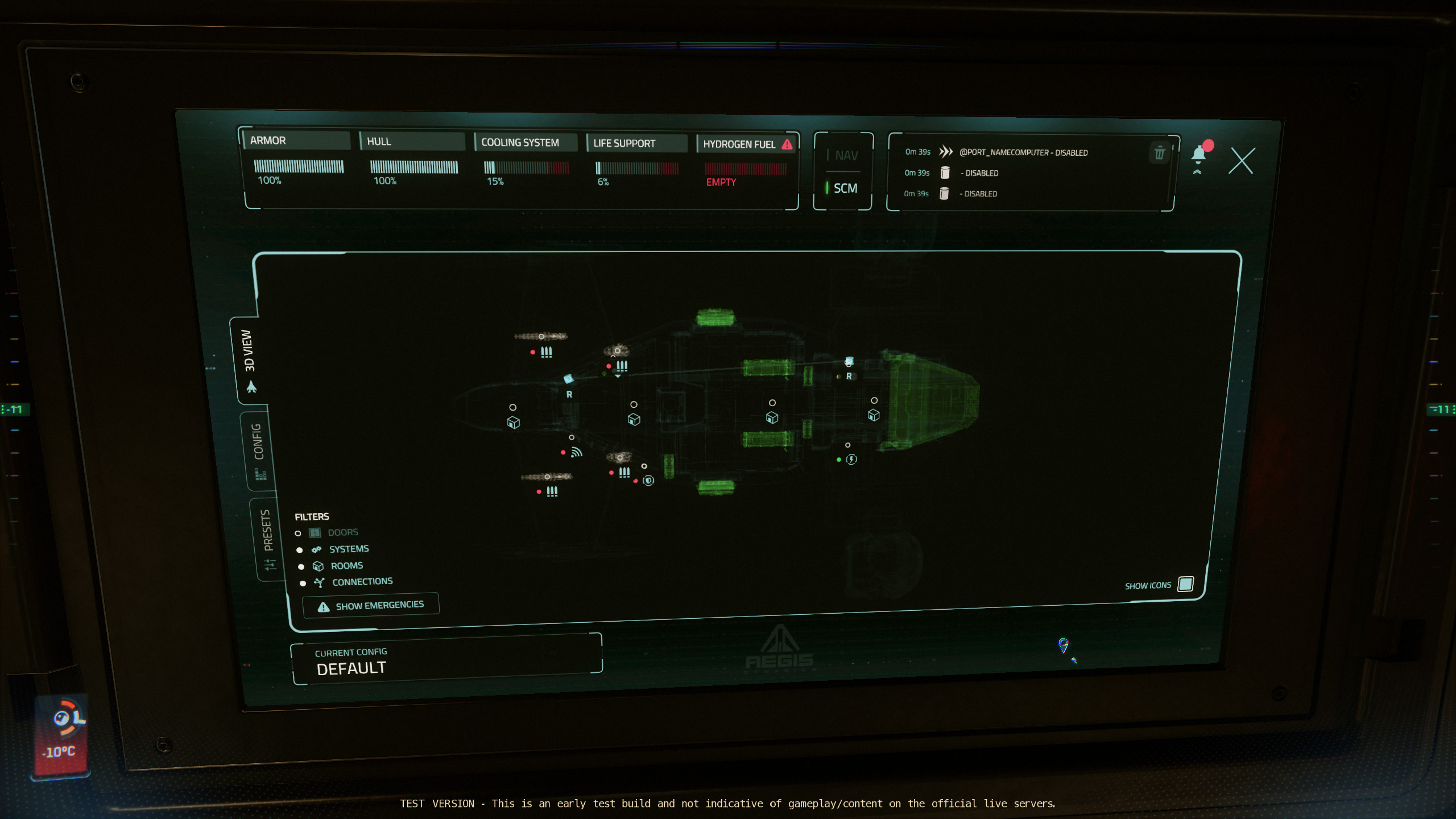
Aside from that, the screens are actually pretty intuitive. By default, we get a 3D map of the ship. Along the top are current health states for the armor, hull, cooling, life support, and hydrogen fuel, which are the most important “survivability” elements. We also get a NAV/SCM state indicator. Next to that is a quick notification panel which can be expanded by clicking on the bell icon. This is one of the worst text displays I saw, making it pretty useless unless the terminal is right up under our noses.
The ship schematic defaults to displaying the systems (weapons, components), rooms (so we can ID a cargo hold from a bathroom), and connections (routes of power between components and their fuses). The doors icons are turned off by default, but clicking any category in the lower left corner will activate or deactivate their display and interaction options on the schematic.
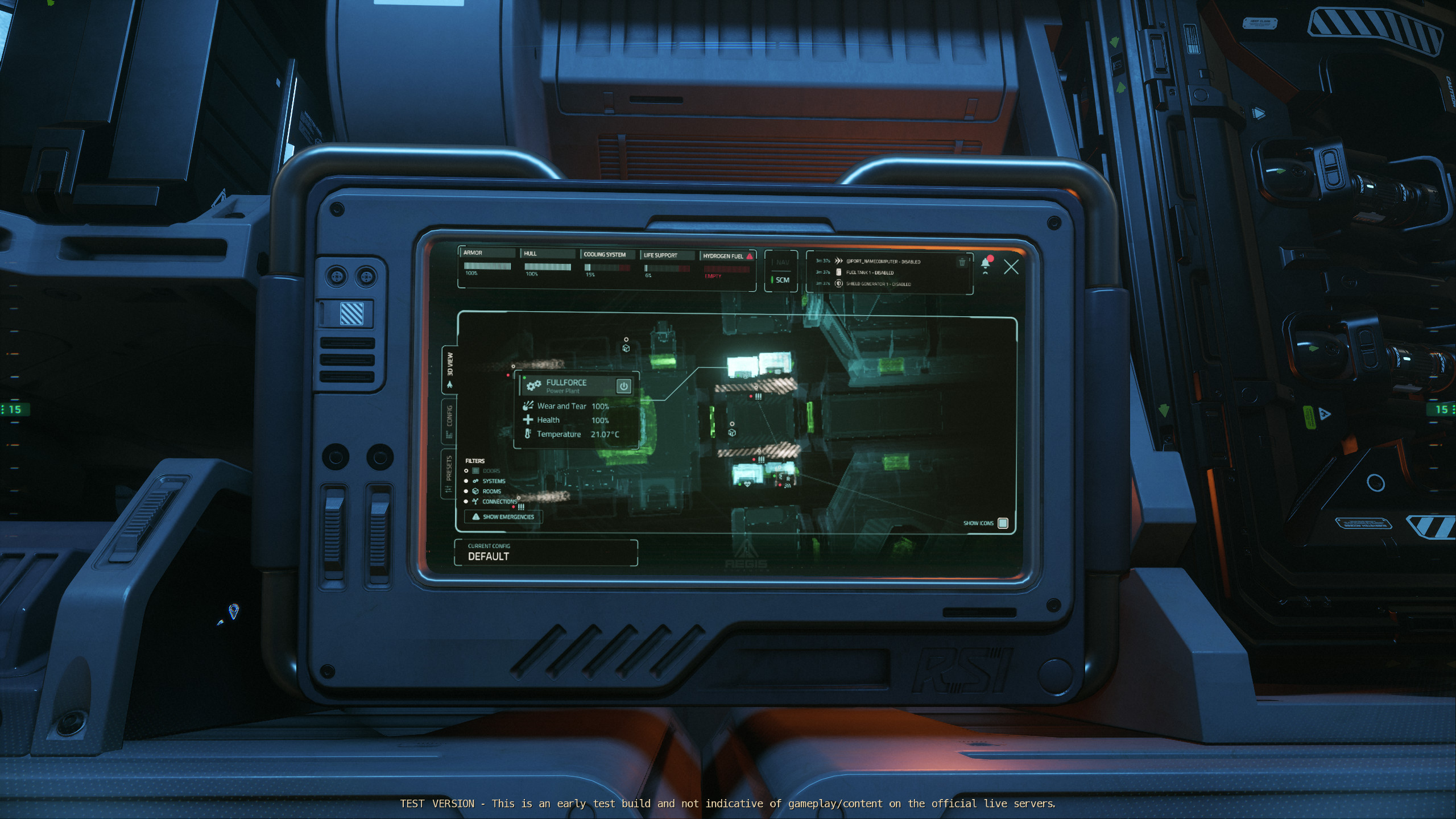
Clicking on an item represented in the schematic will activate a fly-out which displays the brand of component, the type of the component, and it’s health stats. Clicking on a room will display the current temperature and atmospheric pressure. The panel divides the health between “wear and tear” (cannot repair in situ) and health (can repair using the multi-tool and RMC) which I like. It also displays the component’s current temperature. Of note is that for components, there’s an icon which allows us to turn the component on or off. In the case of doors, the fly-out panel allows us to open or close a door, and even lock it…which I did, and which accidentally locked me into the ship as suddenly all of the doors were locked. I went back a few hours later and this bug happened again.
There are two other screens which I didn’t capture for some reason. The first is a display which looks more like the MFD power allocation UI showing “pips” which indicate how much power is available (above the icons for the power plants) and how much is in use (above the icons for individual components). We can turn components on and off from here, and allocate power where we need it. The other screen is the preset management screen where we can save our current power allocation for easy access on the power allocation screen. I suppose this will be useful for “all power to shields” versus “all power to engines”, but I’m having trouble envisioning a situation in between such extremes.
Fuses
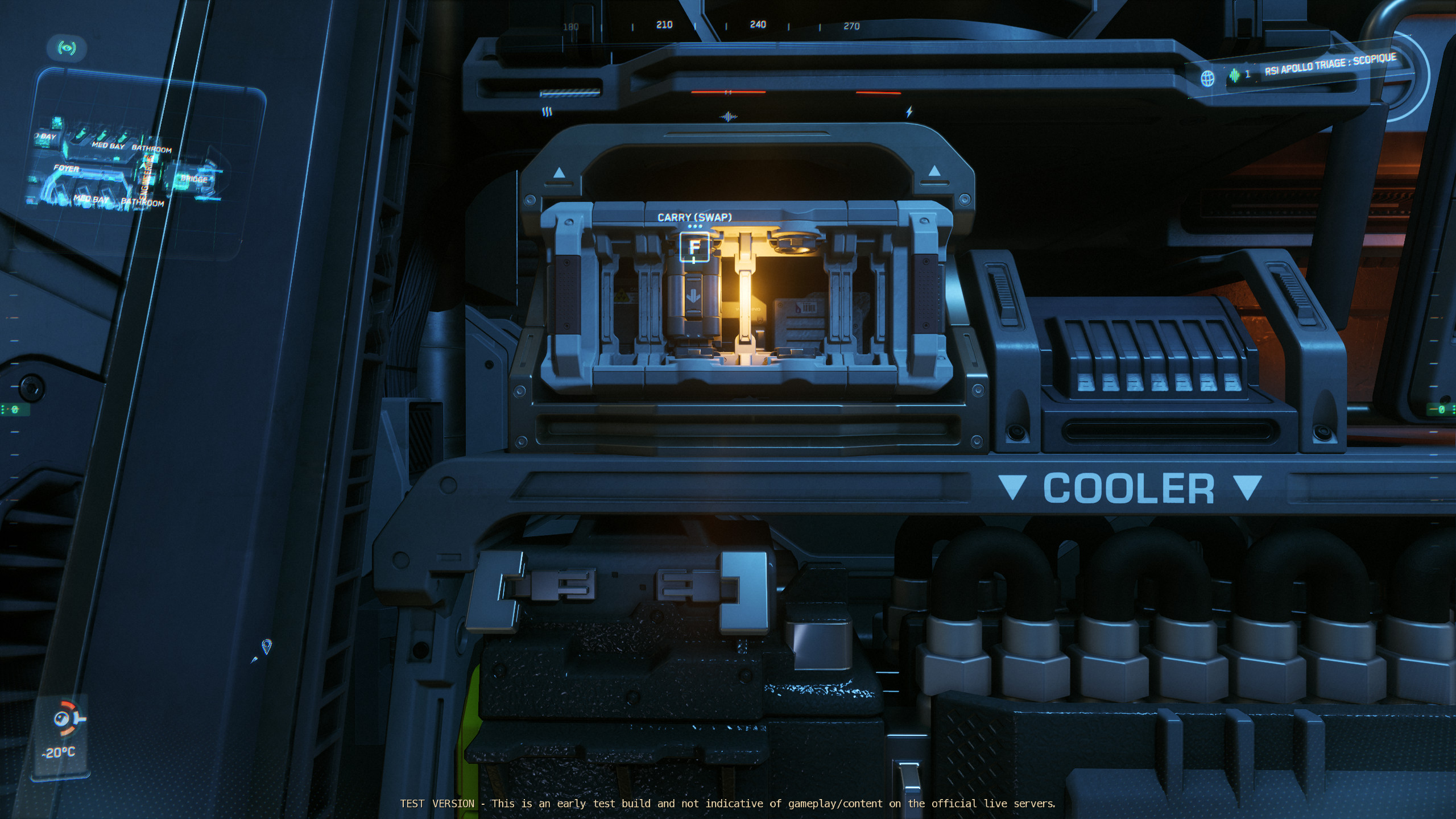
I had a bit of trouble understanding the fuses. Based on what I saw today in the latest ISC (linked below), having no fuses is not a death sentence, but it will reduce the efficiency of power pathways. This can be detrimental or even fatal if the cooling system isn’t getting enough power because that will affect other systems, leading to fire hazards. I removed all of the fuses in the Apollo’s single panel and only saw a reduction of available power pips in the engineering panel’s second view meaning I had less power to allocate around, but I was still able to fully power components assuming I had the pips. Adding one fuse back returned the missing pips, and adding the second fuse back in brought the power availability back to “normal” levels.
Pilot MFDs
I also checked out the MFD from the pilot’s seat but also did not take a screenshot. This is an additional screen which lists all of the things the engineering terminal does, but also includes things like weapons. It display’s the component’s health, and provides an option to auto-repair the component if possible (not sure how this works on a multi-crew ship with only a pilot). The pilot can also toggle the power for any component or entire groups of components, such as all weapons, which matches the functionality that the pilot has in the power allocation MFD.
Addendum to Earlier Thoughts
After watching this week’s ISC video, I feel a little better about engineering. Having pushed a few buttons myself, I’m also now thinking about it in a different way.
Say that right now, in the live server environment, a ship has a survivability range between 1 (destroyed) and 10 (pristine). I have come to accept that taking this healthy 10-rank ship into combat will leave me anywhere between 9 and 1 (more like 5 and 1 but I’m being generous to myself) and expect this, I’m OK with whatever is going to happen happening.
Rather than think about the layer of engineering reducing that 1 to 10 scale to, say, 1 to 7 (for a solo ship) or 1 to 5 (for an under-crewed multicrew ship), I should think about it as increasing the range from 1 to 12 with armor, and maybe to 15 with a well-staffed engineering crew. In this case, I should still be OK in the 1 to 10 range as it’s been what I’ve been dealing with since I started playing. Any survivability past that is just extra that might turn out in my favor.
In addition, the ISC video was shot well before I was able to test in the PTU, and apparently even back then the team at CIG understood people’s complaints. As such, they re-thought their own take on the engineering system and revamped parts of it, such as the way fuses work. In short, they wanted engineering to be more about caring for your ship and not about creating high-tension busy-work just for the sake of creating high-tension busy-work. Engineering should be how we express our feelings for our ships, primarily through preventative maintenance which means that the system allows us to replace or repair (at hangars) worn components before they become a problem, and to do more than just win or lose a battle by introducing damage and opportunities to stay operational longer, even after a fight that might currently and otherwise leave us adrift in space, calling for a pickup in general chat.
So I’m still a bit concerned about the immediate need to run around a ship to prevent it from exploding, but I’m no longer concerned about how much of an impact this will have on my gameplay. Instead, I’m now viewing it as a game system which allows me to take an active role in how my ship performs through regularly scheduled maintenance. While that could be a bit too much like taking care of a car in real life, at least in Star Citizen I’ll always be able to earn way more money that I can use to maybe pay someone to handle the repairs for me.