
 Scopique
 Scopique
Since I have one foot in the TTRPG headspace and since the Steam Summer Sale is going on right now, I pulled the trigger on Mithos, a GM tool for running TTRPG games.
This is not a virtual table top. It seems that whenever some people see “digital products for TTRPGs” they immediately assume or demand that the product is an all-in-one gameplay tool to which both GM and players connect in order to play a game. That is kind of a bummer because I believe that a lot of people who want to make TTRPG digital aides might feel the need to make their product with VTT features such as multi-user, map sharing, and token control, and that marginalizes good ideas that would suffer from shoehorning those features into an otherwise great project.
Mithos is a one-man operation, and that one man has thankfully ignored the siren’s call (and the assumptions of people in the Discord wondering where he VTT features are at) and made this product good mainly for a GM. While it can certainly be used by a GM on their own PC or laptop during an online game, it’s main thrust is to allow the GM to keep track of all of the moving parts of a gaming session either offline or strictly for personal edification.
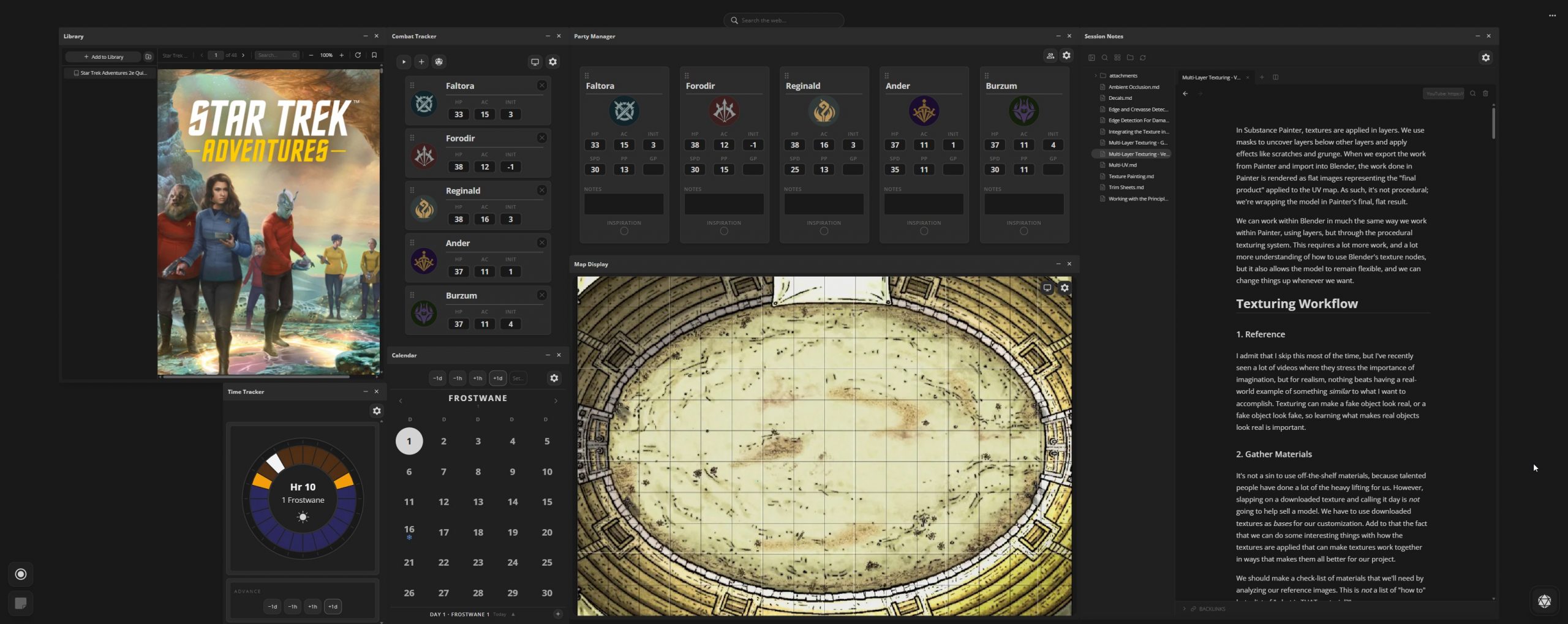
Mithos is modular. Upon opening the app, the canvas is blank. Right clicking anywhere opens a menu from which the GM can choose which panels to display. All panels are locked to a grid which makes alignment and resizing of panels easy in relation to one another, but it also sometimes limits how “tight” a panel can be when displaying it’s content.
What kind of panels does Mithos offer?
- Party manager – View important character stats in one place.
- Combat tracker – Manage turn order for players and NPCs.
- NPC generator, library, and bestiary – Easy access to data.
- Weather generator – For when you need it.
- Time tracker – Also for when you need it.
- Calendar – Just in case.
- Shop generator – For when players want to spend their cash.
- Library – View PDFs and other documents in-app
- Time tracker – For knowing when now is now.
- Map display – Allows drawing, tokens, and FoW.
- Sound board – Play your own audio files.
- Session notes – Load markdown files, loose or from Obsidian, Notion, etc.
In addition, there are a few general purpose tools such as an audio recorder (I believe), popup notes, and a dice roller. All of these panels are designed to allow a GM to create a custom digital “GM screen” for gameplay. As most of these tools are available in the top-tier VTTs, Mithos is less important as a supplement for those products, and is more aimed at groups who are playing in-person, possibly with minis, and ideally without any kind of shared digital space. Are there people like that out there? I suppose there are. I also envision that Mithos is useful for GMs who are running remote games over Discord, maybe more “theater of the mind” affairs where they are the ones who need to track all of the info, or in play-by-post scenarios.
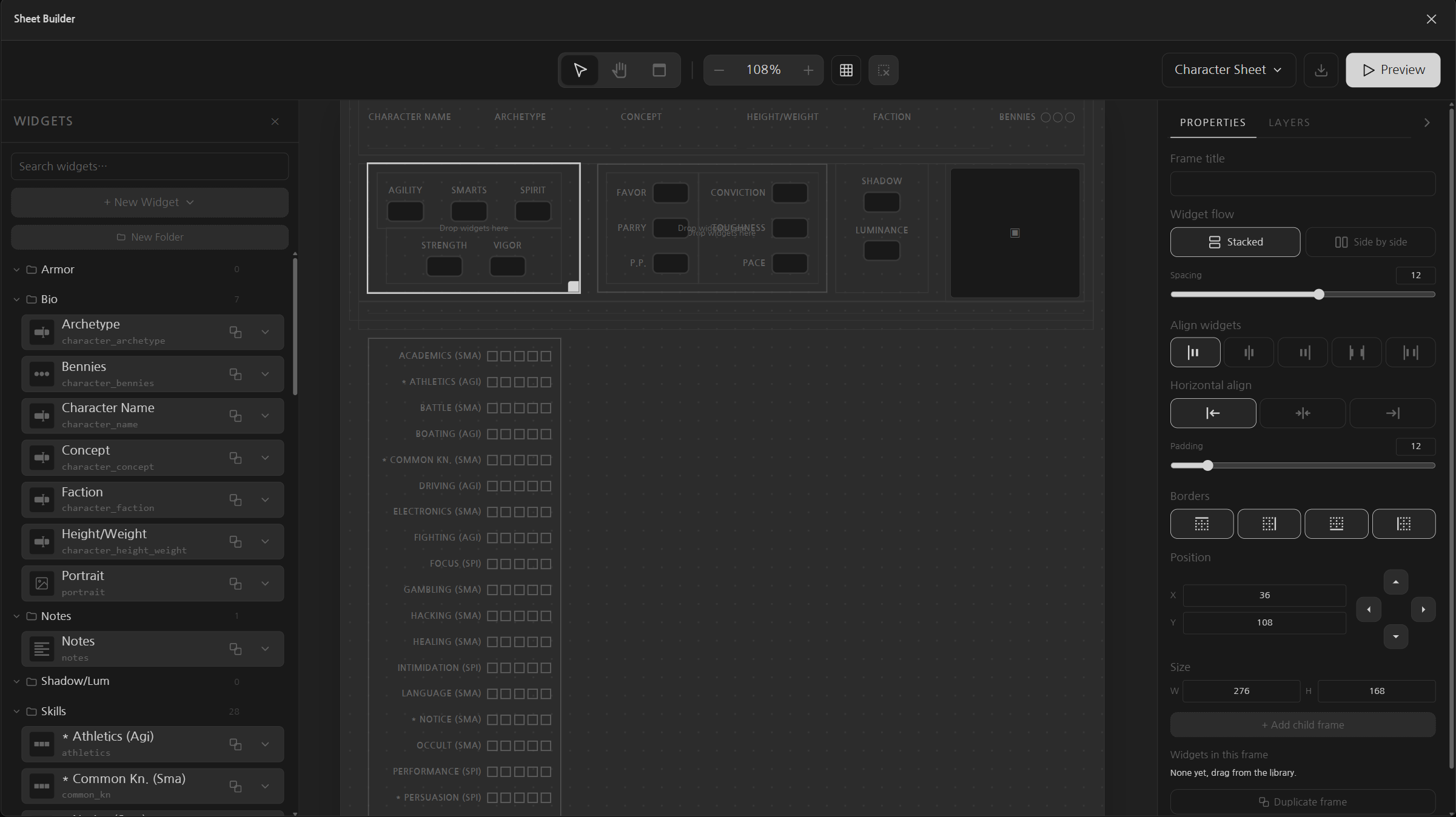
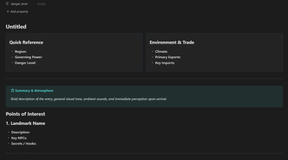
The “pièce de résistance”, however, is the sheet builder. This allows a GM to create any kind of UI form they need, from a character sheet to an NPC sheet to an item sheet to a shopping list, or whatever. GMs can create form elements such as textboxes, number boxes, bubble or checkboxes, images, notes, stats, tables, labels, dividers, and more. Some of the types of fields can be used as calculation receptors, using the values from other fields along with common operators, to generate derived values that will update when the constituent fields are changed. Once a sheet is created, any data entered in an instance of the sheet is stored in that sheet, so when creating a full character sheet and a smaller sheet for use in the combat tracker, the data entered in one sheet will transfer to the other sheet for the same character, avoiding the need to enter the same data for the same character in different sheets. In the image above, you can see my work in progress for a sheet for The Secret World; it’s not the sexiest design ever, but I’m working with the tools I have and it seems to be working well.
Now, here’s the downsides. First and foremost, as with any TTRPG tool on the market, it’s D&D focused out of the box. It comes with one demo “campaign” pre-loaded, featuring sheets and layouts designed for a Dungeons & Dragons adventure. I do not mind this, mind you, because everything is customizable as far as I can tell. For example, the calendar that ships with the default campaign needed to be normalized to the good ol’ Gregorian for my TSW adventure, so I simply renamed the months, added those which were missing, added the proper day names, and everything was as I needed it to be. Some content can be imported and exported, which should make things easier for users to share between then for those who are looking to step outside the safety of D&D. Most of these kinds of modifications seem to be saved with the campaign, so it’s not like I’m screwing up future game system needs, but some elements, such as the map viewer, appear to persist between campaigns which is probably something that shouldn’t happen, IMO.
While the sheet creator is a massive boon, it’s also the most frustrating feature to use. When I created a new campaign for TSW, I still had to remove all of the D&D-centric content, including most of the widgets used in sheet building (I could have just as easily renamed and repurposed the widgets I didn’t need, but I didn’t realize that until later). Then, every field on a game’s standard character sheet needed to be re-created. However, as this is primarily a GM tool, a sheet really only needs the fields that a GM needs to know about. Does a GM need to know every character’s entire skill library? Maybe, but probably not. I’d say that a GM would only need character info that a GM themselves can use for things like passive rolls, HP, SAN, and whatever helps GM’s make decisions regarding the character and the character state.
The biggest gripe I have with the sheet builder is how cumbersome the layout tools are. Each widget needs to live inside a frame because the layout is governed by flex-box rules (column, row, start, center, end, top, middle, bottom, space-around, space-between). This requires that the designer think about how to structure the layout before throwing down the first element because while widgets need to be inside frames — sometimes frames within frames to really control layout — moving a frame does not move the widgets inside. That makes it incredibly difficult to move a well-placed set of widgets as a group. If widgets need to be re-ordered within their layout, then the designer needs to use a very clunky outline-style representation of all frames and widgets to move things around, and most of the time the re-ordering doesn’t work correctly.
There are a few other minor annoyances, mainly the resolution; on my ultra-wide monitor I had to crank the text size up to “large” (130%), and then had to use CTRL + Mouse Wheel to zoom in further, lest the panel content be so small not even a teenager with 20/20 vision could see it. Ultimately I don’t consider that, nor any of the other gripes, deal breakers as everything is annoying because of my personal notions on what the app should be doing, and once I learned how the app decides to do things, I got into a groove. The app is still being developed. The sole developer is always on Discord, is chatting with users about bugs and features and seems to be pumping out significant updates at a furious pace.
I am extremely particular about the tools I use in my creative endeavors because I somehow believe that the tools will help me in times of cerebral crisis by opening the floodgates of imagination. It’s easy for tools to get in the way of wanting to “do something”, especially when I have an idea that my tools won’t support. That’s why I like to have bells and whistles and kitchen sinks galore, even if I never use half of them.
I really don’t have a need for Mithos. I am not playing nor running any games, and if I were, they would probably be through a VTT. However, I thought that since I am trying to put together a TSW adventure, this might help by allowing me to create the NPC stats, throw in the maps, and have everything nicely arranged around the window to my Obsidian .md files for editing. I have been thinking that maybe I could eventually run this adventure as a play by post (I recently saw someone say they were playing by post, which is why I have the bug in my ear) and I think Mithos would be a good dashboard to help me keep track of everything that’s going on over time.


1 Comment
Tipa
June 28, 2026 - 3:26 pmI could have used this when I was running DCC. It was in-person, and I was trying to track all these things with various post-it notes 🙂
Comments are closed.