Scopique
 Scopique
As much as I like the technology, my use of VR is extremely limited. I use it on occasion to play Elite Dangerous and have tested it with Star Citizen, and seeing both in VR is, without hyperbole, a complete game changer. For a while, I was playing Minecraft in VR as well. I don’t generally use the Quest 2 that I own for in-headset games, though. The only time I did was for exercise apps such as Beat Saber — I consider Beat Saber to be exercise, yes — and Supernatural.
Color me bummed, then, when I learned late last year or earlier this year that Meta was closing down Supernatural. Meta went all-in on VR, as I think we all know, and it didn’t pan out for them like they’d hoped, as I think we all know. In order to free up their “misadventure money” for another misadventure (AI), they started trimming their internal VR budget, ceasing projects and closing internal studios like the one that was in charge of Supernatural.
VR is an amazing thing, but it just doesn’t have a daily use case or the convenience of desktops or laptop PCs, or tablets or cellphones. Aside from niche uses like industrial viz or total immersion gaming, I think that exercise is a great reason to keep the dust from settling on the headset, so when I heard that Supernatural was being closed, I was sad. I tried to move to what looked like a competing project, but — surprise! — it was a total AI cash-grab with simulated coaches and generic AI-generated music.
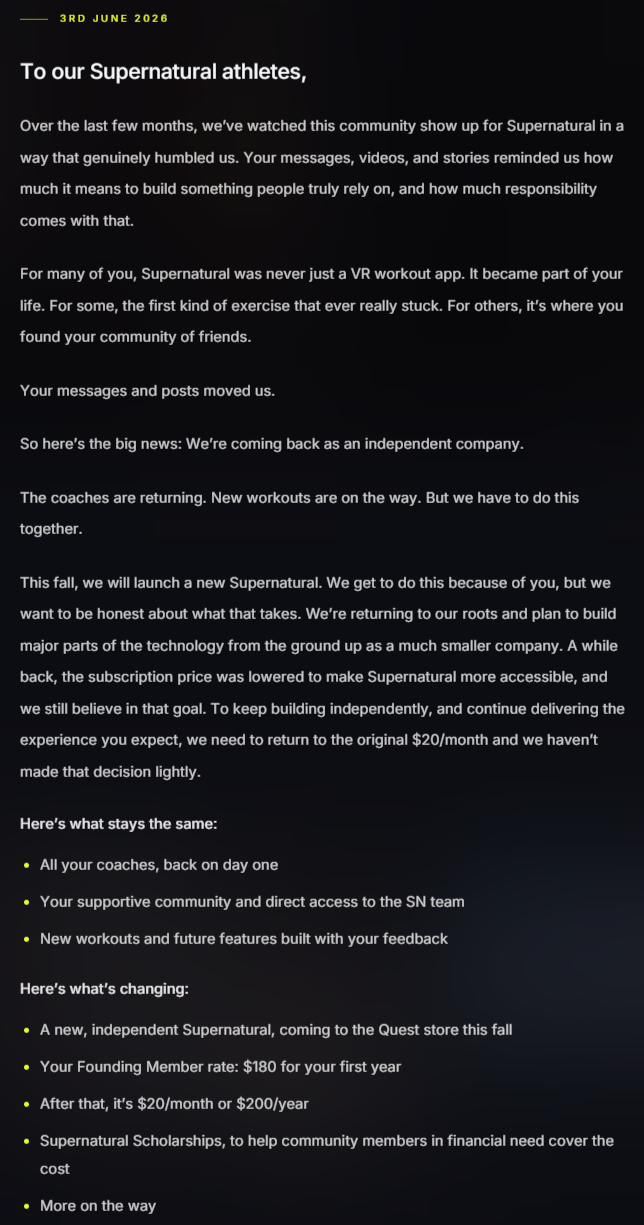
This morning while waiting for my coffee to brew, I was scrolling through the things I’d missed after I went to bed last night and saw, to my excitement, that Supernatural was spinning off as it’s own company.
I liked Supernatural more than other exercise apps I tried mainly because it was focused on the exercise, not on evangelizing the VR headset. It offered boxing, a Beat Saber-like experience, and a kind of guided meditation mode. I liked their boxing routines because they seemed to focus on boxing fundamentals (as far as I, a non-boxer, could tell). Their Beat Saber mode was OK, and I had only tried their meditation mode once but didn’t really have any use for it. At the end of the day, the routines got me moving and my heart pumping, and I always enjoyed how annoying it was be a mostly sedentary person who felt like he was going to pass out after a workout. I actually didn’t even mind the relentless cheerfulness of the coaches and their incessant voice over encouragement during the routines. Rather than go out to a gym — a decision which has built in excuses for not going, especially during the winter months here in the Northeast — Supernatural provided a measurable, fun, and difficult-enough workout for me in the comfort of my own home, using hardware I already owned.
My only concern is what becoming an unsubsidized entity will mean for the quality of the product. $20 per month is a pretty big jump from the $10 per month of what is now being called “Supernatural – Legacy”[1]. I suspect that this is plainly calculated in order to keep the trainers employed, sure, but mainly because unlike that AI-generated app I had tried, Supernatural used actual, popular music that I recognized (mostly). I really hope that the new Supernatural will be able to continue to license real music because I found that it mattered to me; while the AI-generated music was “OK” and did the work of being suitably up-tempo for it’s purpose, I found that having some kind of actual connection to the music was important to my enjoyment of the exercise.
Here’s the good news, though. Splitting off from Meta means that Supernatural can show up on other headsets, including the recently released Steam Frame. Yes, while VR adoption is probably well past it’s heyday, I have to believe that there are many, many VR fans out there who would love to see another modern, viable player in the VR space, and would love to get out of the Meta ecosystem (me. I’m one of those people). Being independent means that Supernatural can reach more people at the same time the Steam Frame does, and I think that’s a great path for them.
[1] Not wanting to cut their nose off to spite their face, Meta is still offering the original Supernatural app for the time being. Since they were content to close the studio, they were obviously OK with not producing new content for the app, instead relying on what had already been recorded. I don’t know what that means for the legacy experience, though, since it used licensed music which, as I think we all understand, is never granted in perpetuity, and we don’t know how long or even if Meta will continue to pay license holders for those rights in the future. Still, the legacy app’s subscription is currently still at $9.99 per month if you’d like to get a feel for what Supernatural has to offer, ahead of the rollout of the new version.