
 Scopique
 Scopique
I’m a bit miffed that pound-for-pound we are drowning in Star Wars games of middling to excellent quality while we haven’t had an even good Star Trek game in years…maybe decades. It’s relatively easy to create content in the Star Wars universe because gamers like to shoot things and play space wizards with laser swords like it’s not silly at all, but translating a franchise based around speeches on morality and the Human Condition, and made-up-on-the-spot nonsense is much more difficult. That’s why Star Trek Voyager – Across the Unknown is a rare gem that understands how to meld the complexities of adapting a Star Trek property with a “trust me, it’ll work” attitude.
The song remains the same
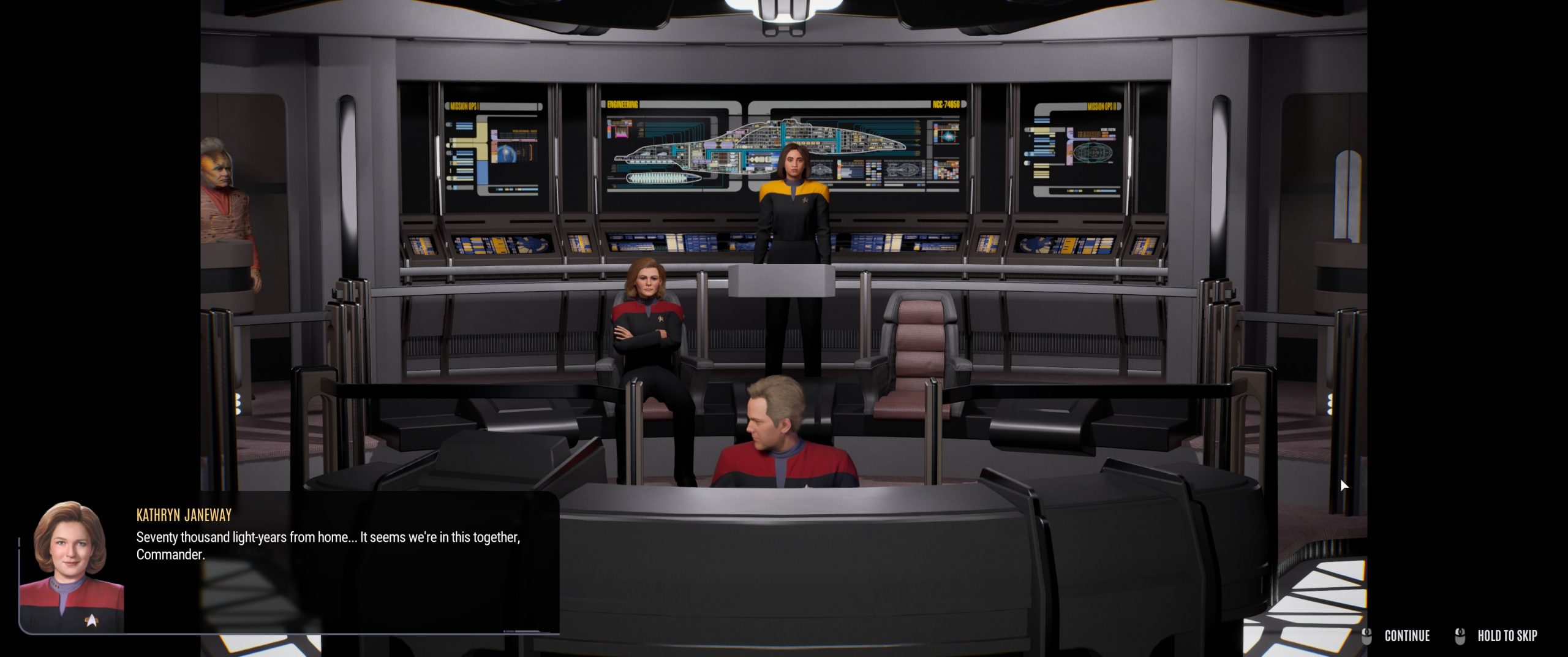
The story of Voyager is unique in the Star Trek universe, which seemed to be de rigueur at the time that Paramount was pumping out Star Trek shows in the mid- to late-90’s. TNG was a traditional exploration show, but Deep Space 9 focused on a static location and the trials of life at an intergalactic melting pot. Voyager was a lot darker (at least in Star Trek terms): it focused a smaller Federation ship kicked into an entirely different galactic quadrant, setting the series to focus on the crew’s lonely attempt to make it back home. Each week, Voyager was on the verge of breaking down or blowing up, crew members were killed or left behind, and enemies harried the ship as if Starfleet owed them money. There was an actual episode entitled “The Year of Hell” which covered one whole year of the ship’s difficulties and was one of the bleaker episodes in the series. Compared to the often times vague hand-waving that DS9 used to move the Dominion War through it’s paces, Voyager had the worst time of any televised starship crew to date.
Rather than make the game a “continuing mission” for Voyager after the series, developers Gamexcite simply leaned heavily on the narrative of the show. The good news is that you don’t need to know anything about Voyager: The Series, although if you do you’ll get a little extra gas in the tank. And if you do know anything about the series, there’s some notable curve-balls you can expect.
It’s been a long road…
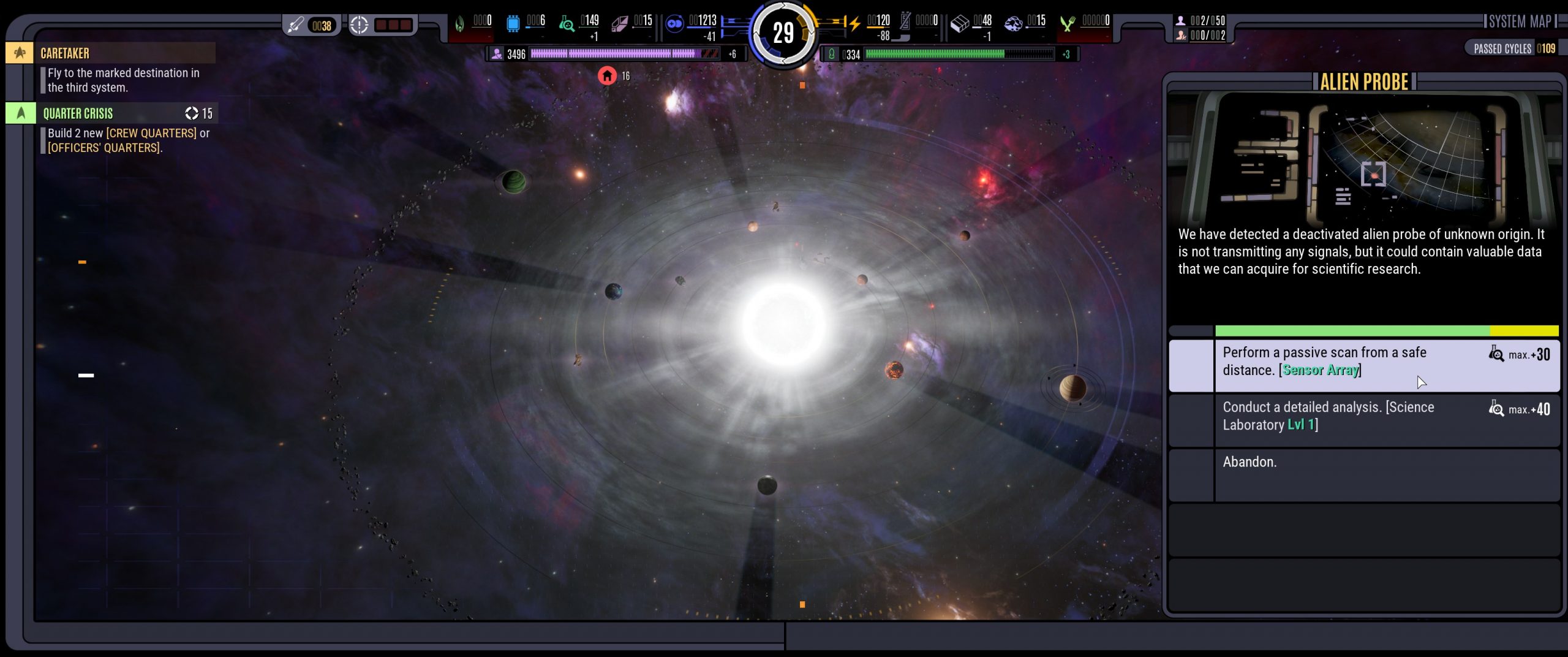
In STV, we are tasked with taking Voyager through several different star systems as we move in the general direction of the Alpha Quadrant. The first order of business upon entering a new system is to scan all of the points of interest. Each POI can offer materials such as deuterium, duranium, dilithium, and food, provide repair services, trading opportunities, or story beats.
Each “turn” uses deuterium, food, and other resources; flying between POI can be nail-biting as we watch the cargo values tick down. The first and most important order of business in the game is to manage these resource which can lead to staring at the solar map to calculate the most efficient route through the system to minimize spend and maximize collection. Some POI offer missions, interactions with the locals of the Delta Quadrant, or combat with well-known enemies from the TV series.
Housekeeping
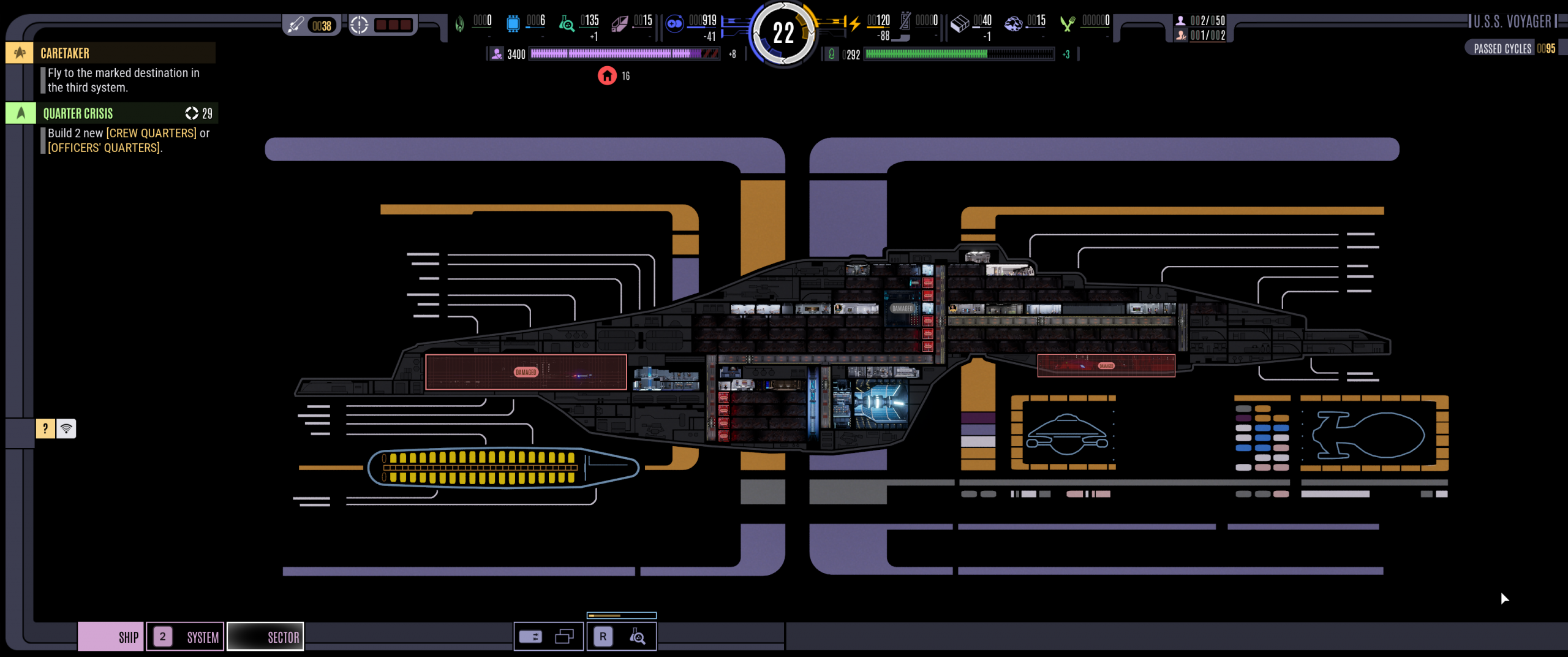
The second most important part is getting the ship back in order. After arriving in the Delta Quadrant, Voyager is worse for wear; most of the decks are offline and ruined, so the short-team goal is to restore operation to the ship one deck and one deck section at a time.
After clearing debris, deck sections are ready for assignment. It’s up to the player to determine what goes where, starting with crew quarters, then working up to rooms for additional storage (more resources), batteries (to store power to keep these rooms operational), and specialty areas (hydroponics, science labs, shuttle bays, etc.). Each assignment takes duranium and time, at a minimum. As more rooms are unlocked, additional materials become necessary such as bio-neural gel packs. Some of these rooms are passive, like the crew quarters, but some are interactive, like the workshop or science labs. These specialty rooms can accommodate crew assignments from the roster of Well Known Voyager Characters. The Doctor is best assigned to sick bay, for example, and Torres is best assigned to engineering. These assignments provide bonuses for the rooms.
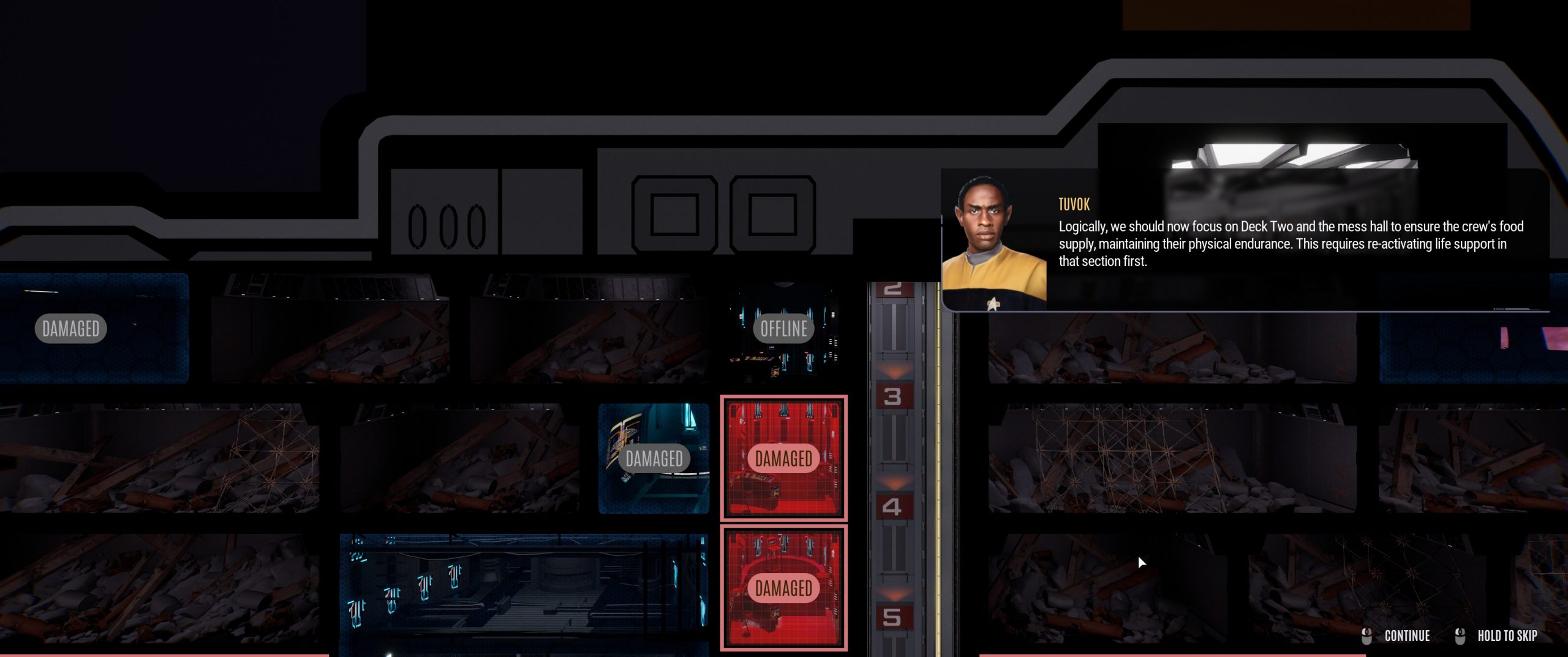
Rooms can be toggled on and off to save resources, and can be upgraded to provide more benefits. After combat or unlucky story interactions, rooms can be damaged and must be repaired. It’s an ongoing process to make Voyager space-worthy and keep her running, in between everything else we have to deal with.
Ship combat
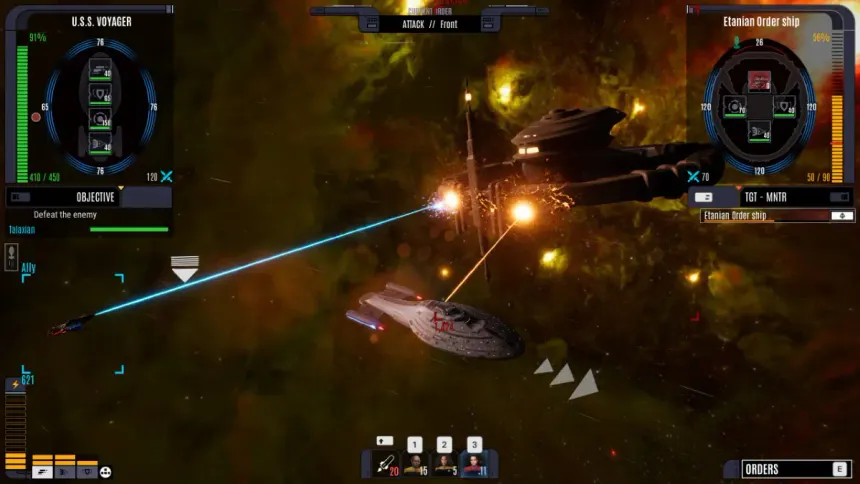
Since Voyager made as many enemies as they did friends in the Delta Quadrant, we can expect ship battles to be a thing. Thankfully, it’s pretty simplistic and can even be auto-resolved. Most of the player interaction comes in the form of decision making. The ship will move about on it’s own, responding to the player’s orders to target different ships and different systems of those ships. Photon torpedoes can be fired manually once a target’s shields are down.
Before going into combat, players can choose up to three different crew members, each of whom has their own tactical abilities that can be manually triggered between cooldowns. These can add evasiveness or boost damage or increase speed and turning for a spell. In the end, we’re given a screen recounting how many wounded crew members we gained, the damage to our ship, and any resources we might have gained as a result. This is, of course, if we survive the encounter.
Away missions
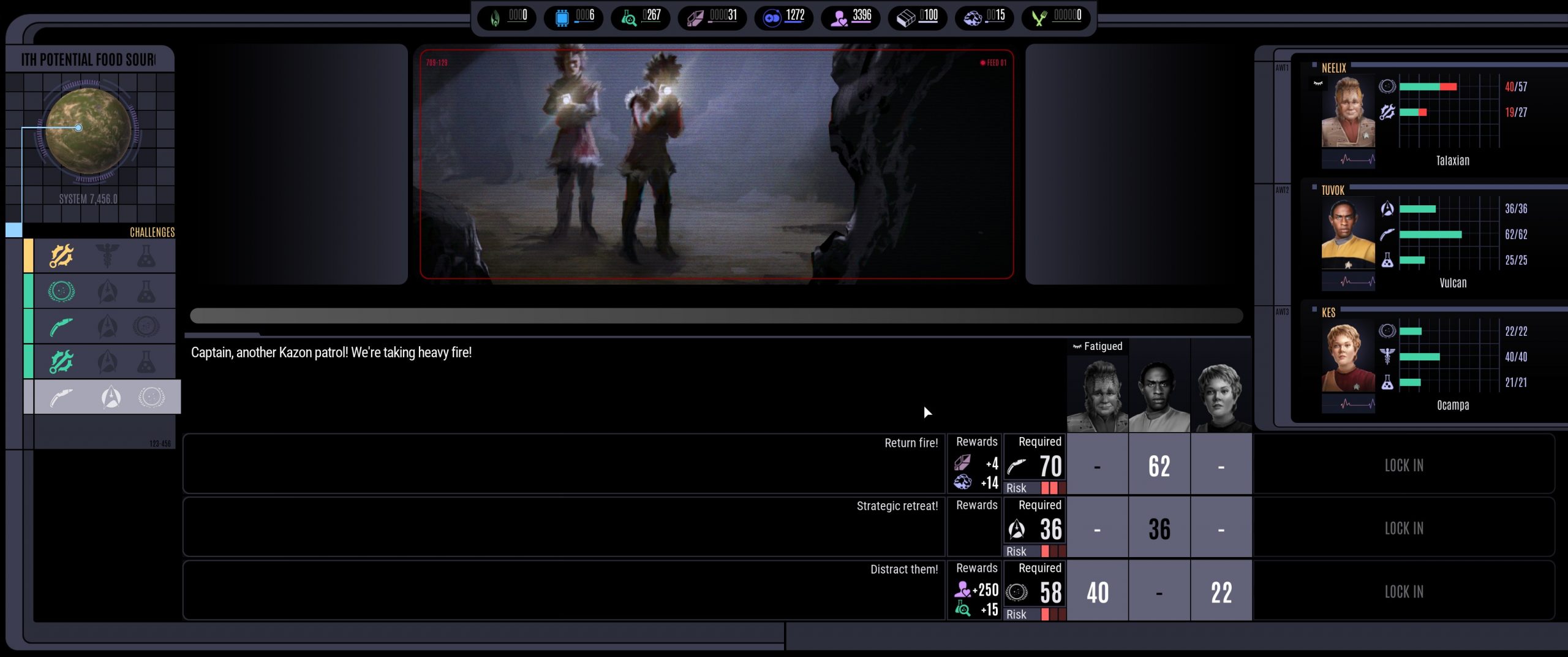
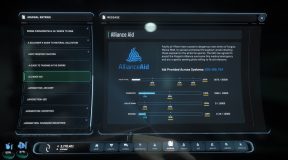
On occasion, there will be times when away teams must be assembled. We select up to three named crew members, each with two or three different specialized skill areas. On the left of the screen above, we see the different “scenes” in the mission, each with up to three different specialization needs. The key is to ensure that all of these specialty needs are covered before beaming down.
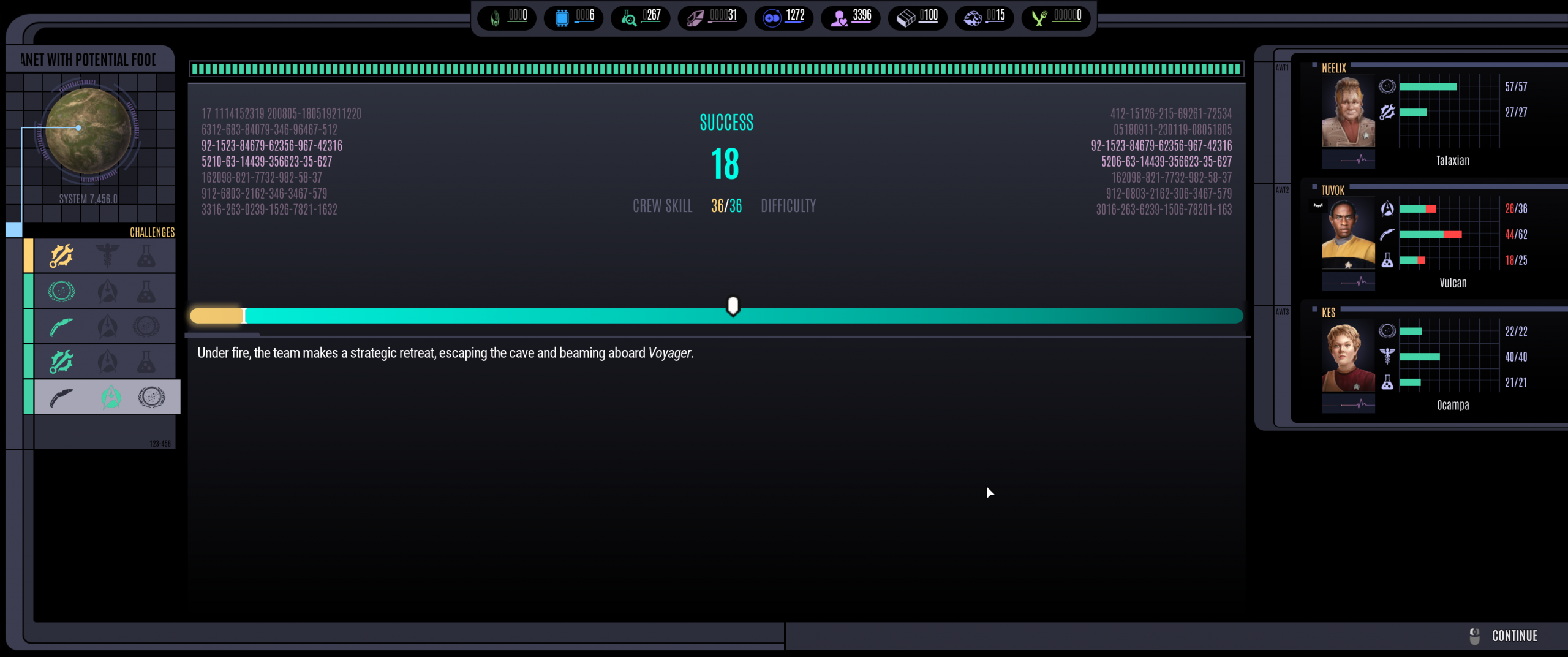
Once in the mission, each scene will provide up to three different options. We choose one or more crew members whose specialization can beat the proscribed difficulty. Each option can also provide us with some benefits such as duranium or crew morale. At the end of the mission, the away team earns XP and whatever they can carry back to the ship.
And the beat goes on
I commend Gamexcite for taking a big chance with STV, and that’s the fact that they threw in the plots of several of the series’ episodes. For example, I have thus far experienced the episodes Caretaker (the tutorial), Phage, Eye of the Needle, State of Flux, Faces, and Jetrel. For those following along, the missions in the game bear the same name as the episodes of the series so it’s easy to keep track of what’s going on if you’re familiar with the Voyager series.
Except…
Adding another pat on the back for Gamexcite, they offer choices that could have been made in the episodes, but which were obviously not taken for narrative reasons. As I mentioned in a previous post, players can actually send Voyager home at the conclusion of Caretaker by making a different decision from the one made in the show. Obviously, that has consequences for the rest of the game. In other cases, consequences can be…stranger. Just this morning I completed Faces, which saw Torres split into both human and Klingon versions of herself. In the show, the two were reconciled back into one Torres; in my case, I failed the merge and ended up with both a human Torres and a Klingon Torres, both of whom are now part of my crew. I find this to be an absolutely fascinating divergence, as it keeps the narrative waypoints intact, but makes the story its own by letting us choose — or be forced into — paths that differ from those made in the series.
I’m now waiting to see how the “Tuvix” situation is going to play out.
Weathering the storm
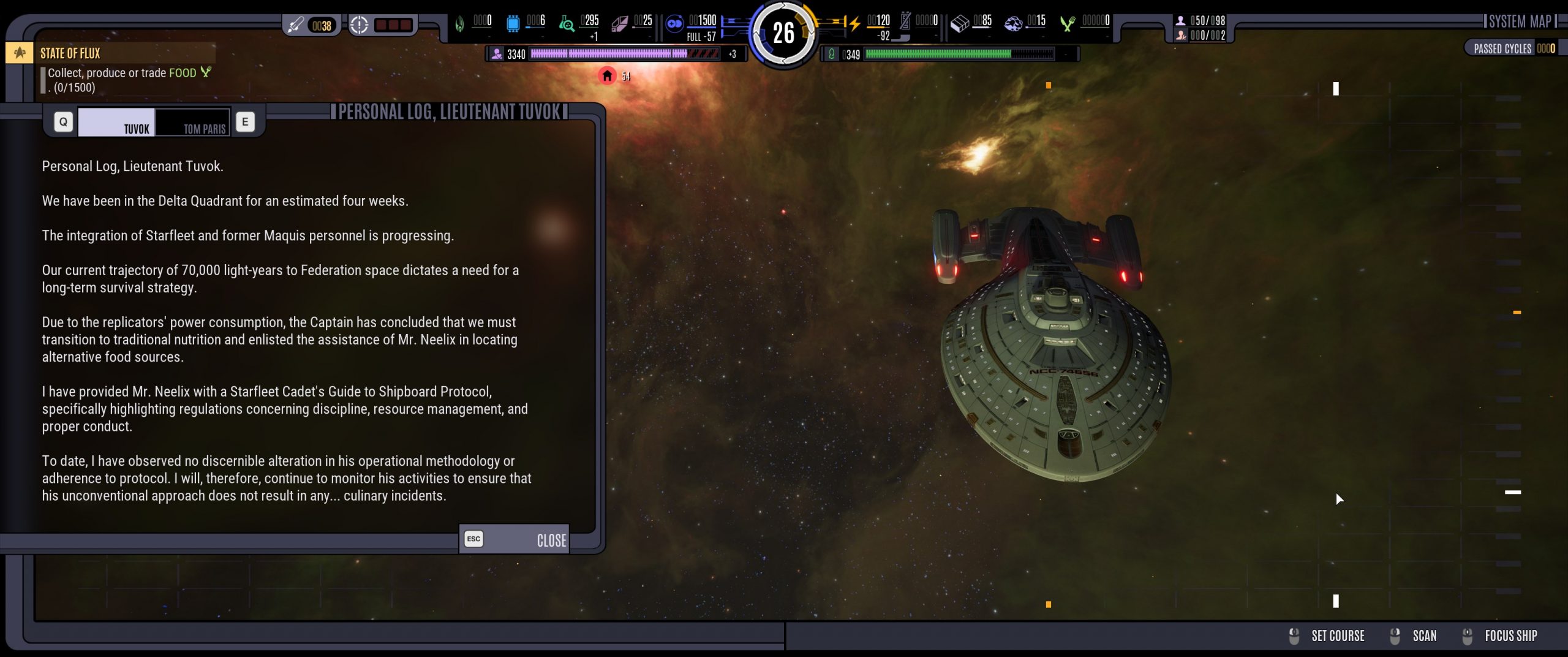
After the demo was released, people got uppity because none of the characters are voiced. I kind of agree that this does suck. Not only is it kind of weird to only read conversations, but as a licensed product, I wonder why no one used any clout to get the actors to throw in their lines. If all of the crew had voice actors — even if they were only sound-alikes, an option that I think would appease — this would go from a good game to a great game. In the end, though, they did get Tim Russ (Tuvok) and Robert Duncan McNeill (Tom Paris) to appear, but only through the occasional chapter crew log voice-overs.
There are also some bugs that Gamexcite are rushing to squash. Early on I lost a game save because I got locked out of placing a room and couldn’t exit that mode, forcing me to CTRL + F4 the game. Thankfully that’s been the only issue that I have encountered, though patch notes illuminate problems that others have identified. Still, this is not a warning; STV doesn’t have any catastrophic bugs that I have seen, and aside from that one time, everything has been smooth for me.
Going home
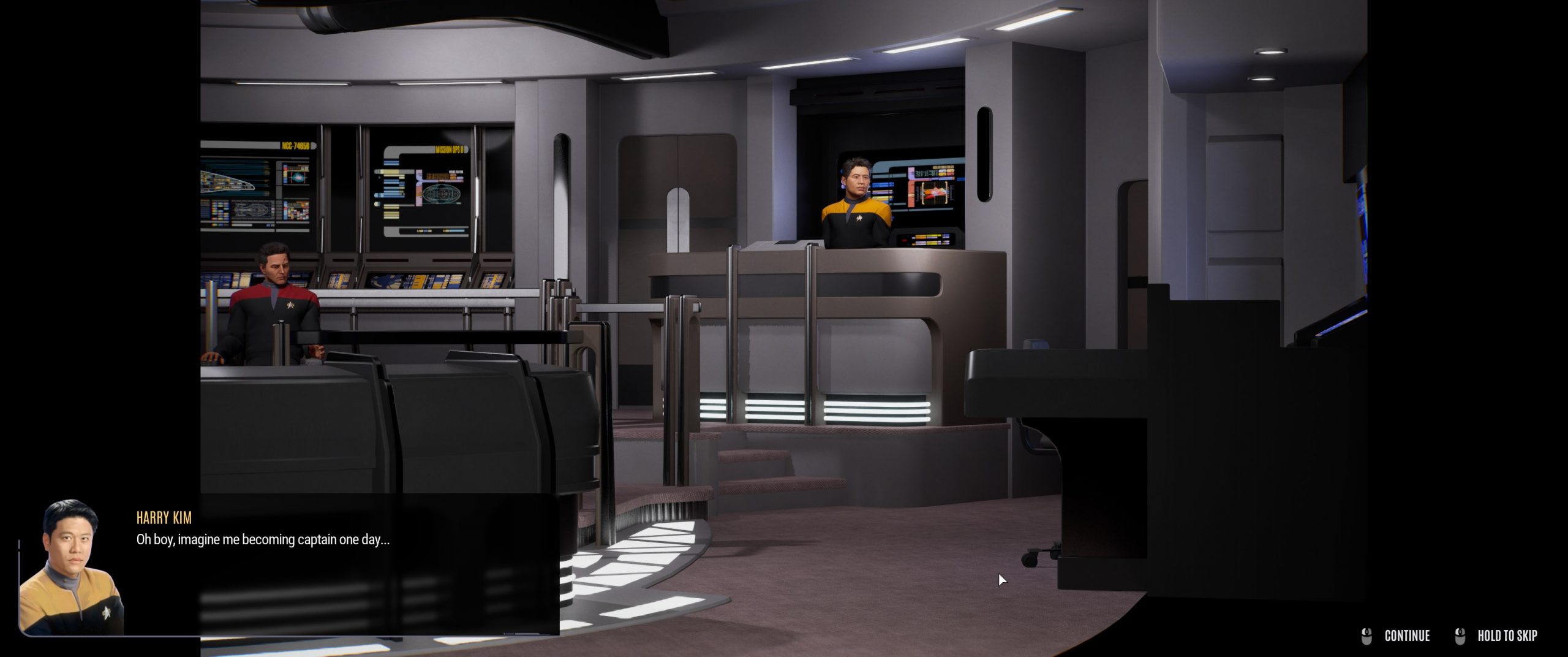
I am exceptionally pleased that Star Trek has finally gotten a game approaching the value of the franchise. It’s not a grand strategy game (Paradox released and quickly abandoned that one for baffling reasons) or a narrative game like the spate of Trek games from the late 80’s and early 90’s, nor is it a shooter like, surprisingly, another Voyager game (Elite Force). STV reminds me of mobile games like Fallout Shelter and Star Trek Timelines, of all things, but writ large for desktop machines. I would not be surprised if we do see a mobile version at some point, although I was playing on the Steam Deck this morning and some of the text was hard to read. A mobile edition would need some layout changes if it ever does materialize.
That being said, I don’t know if this is a game for every Star Trek fan, although I cannot see how it couldn’t be. The mechanics are tailor-made for the Voyager narrative, so Gamexcite’s design decisions are on target as far as I’m concerned. Following the arc of the series was risky, re-treading the same stories that some folks probably know well enough to “game the system”, but then by allowing us to take our own paths in some cases we get to alter the timeline to create entirely new stories and new situations. I think there’s something special in that. It’s Voyager…but also not Voyager. I don’t know of any other games out there that let players experience the stories they know, as they all seem to extend beyond another medium’s expiration to give “more of” instead of “the same as, but different”.
My only complaint is that I find myself getting very tense as my resources tick down. Sometimes I end up in a system which has an overabundance of materials I don’t need, not ones I do need, and I start to sweat. Even though I’m sitting in my pajamas at my PC in my warm basement, I kinda feel like I know how Janeway, et al. felt on their way through the Delta Quadrant, and I’m glad my commute is only two sets of stairs each day. I do make several stops at the coffee machine, though, just to keep it real.


4 Comments
Tipa
February 21, 2026 - 8:26 amBeen on the fence about this. I think people were saying you couldn’t save very often? PROBABLY gonna get it, though.
Scopique
February 21, 2026 - 10:33 amYes, it only auto-saves, but Gamexcite have been looking into allowing for manual saving, if I’m understanding their latest update post correctly.
Nimgimli
February 21, 2026 - 11:11 amThanks for this. I just assumed it would be another cash-grab feeling Star Trek game, but NOW I am interested!
Scopique
February 21, 2026 - 2:00 pmGood point. It does seem like all of the recent Star Trek games have been on mobile, and with it comes monetization. There was a dust-up at launch because the “deluxe” version included some additional missions and crew members and of course people were upset because they believe that such things should be in the base game not day one DLC, but it’s 2026 and /shrug. I got the deluxe edition because I liked the demo and want to support the devs for making a good Star Trek game.
Comments are closed.